Call analytics
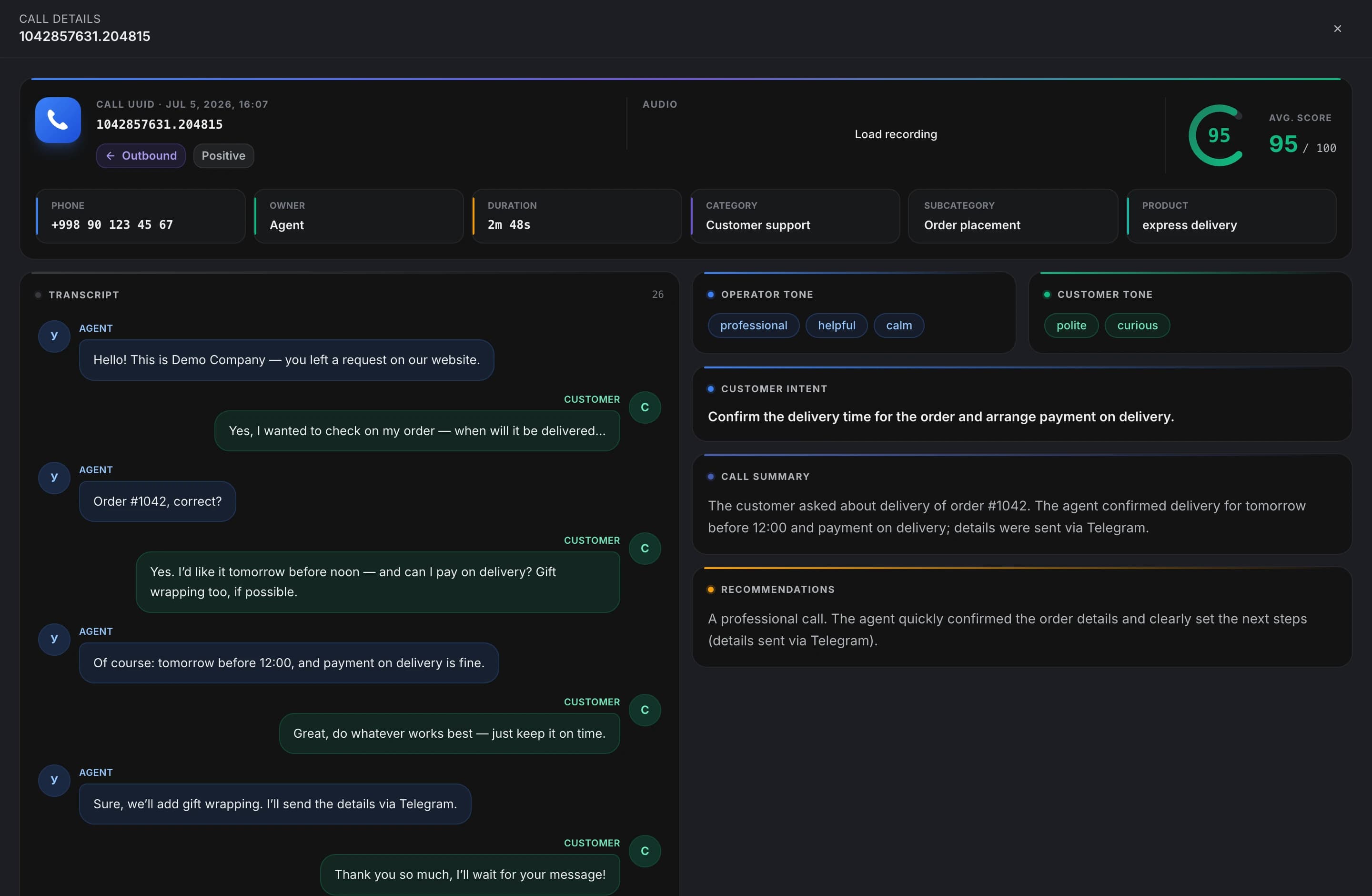
Transcribes and scores 100% of calls: quality score, voice tone, conversion and search across conversations. From the Business plan.
About call analyticsOur own models turn calls and voice into text in Uzbek, Russian and English — including a switch to Russian mid-sentence, dialects and noisy phone lines. The transcript lands straight in the CRM and call analytics.
Zukko.AI speech-to-text is the speech recognition layer built into the Zukko.AI platform: its own models turn calls and voice into text in Uzbek, Russian and English. Zukko.AI is a platform of AI agents for business: the AI employee (AI agent) replies to customers in every channel, calls them and keeps the CRM up to date. The language is detected automatically, and when a speaker switches from Uzbek to Russian inside one sentence, recognition follows the switch instead of losing the second half. Every call becomes a diarized transcript with timecodes, agent and customer separated, and Uzbek written in Latin, Cyrillic or with different apostrophes is brought to one spelling. The models are fine-tuned on labelled real phone calls and a glossary of terms, and streaming recognition removes the pause before an answer. Call analytics, the voice AI agent, CRM voice control and Zukko Recorder all run on it — it is part of the platform, not a separate product.
How Uzbek speech recognition works in productionRecognition runs inside the platform: you connect a call source, and the rest happens automatically.
A call from your PBX through one webhook, a recording from an Android phone via Zukko Recorder, a voice note in the inbox or a live conversation with the voice agent.
Streaming recognition detects the language and follows a switch from Uzbek to Russian inside one sentence instead of picking a language once at the start.
Agent and customer are separated, every line gets a timecode, and Uzbek in Latin, Cyrillic or with different apostrophes is brought to one spelling.
The transcript is attached to the customer record: call analytics scores it, the voice agent answers on it, voice control carries out the command.
The same models turn speech into text wherever voice enters Zukko.AI.
Transcribes and scores 100% of calls: quality score, voice tone, conversion and search across conversations. From the Business plan.
About call analyticsHears the customer on the phone and answers in Uzbek, Russian or English; anything outside the script goes to a manager with the transcript.
About the voice AI agentCommands in Russian and Uzbek: find a customer, create a task, open a report — Ask Cell recognises the speech and acts in the CRM.
About voice controlAn Android app records work calls from an employee’s phone and sends them for transcription — no separate PBX needed.
About Zukko RecorderA model that is confident on a clean recording makes mistakes on a live call. Six reasons, and what we do about each.
| On a live call | Out-of-the-box model | Zukko.AI |
|---|---|---|
| Uzbek ↔ Russian switch inside a sentence | The part after the language seam is lost — exactly where amounts and service names are said | Language detected automatically, code-switching handled separately |
| 8 kHz phone channel | Compressed audio, noise and interruptions: the model drops words | Fine-tuning on labelled real phone recordings |
| Dialects and accents | Regional words are replaced with similar literary ones | Labelled calls from different regions, a check on the customer’s recordings |
| Names, amounts and terms | Written down wrong, terms flattened into common words | A glossary of terms and names, labelled industry dialogues |
| Three ways to write it | The same text arrives in Latin, Cyrillic and with different apostrophes — search and reports diverge | The transcript is brought to one spelling |
| Delay before the answer | Waiting for the end of the sentence leaves an audible pause | Streaming recognition instead of batch |
For reference: the open Uzbek Speech Corpus holds 105 hours from 958 speakers, and its authors report a 17.4% word error rate on the test set (Musaev et al., 2021). It is read speech with no phone conversations — that data has to be collected and labelled separately.
Engineering breakdown: Uzbek speech recognition in productionLeave a number — the demo call runs in Uzbek or Russian.
It takes 2 minutes — nothing to connect or set up.
No. It is the recognition layer of the Zukko.AI platform and works inside call analytics, the voice AI agent, CRM voice control and Zukko Recorder. Transcripts appear where you already work — on the customer record and in call reports. You can check recognition on your own recordings during a demo call.
Uzbek, Russian and English. The language is detected automatically and switches mid-call, so you do not have to set it in advance. English brand names and terms inside Uzbek or Russian speech are recognised without distortion. Voice control commands work in Russian and Uzbek.
Code-switching is handled separately: the system does not force the speaker to stay in one language, it detects the seam and continues the sentence. Without that handling a model loses the second half of the sentence — which is usually where numbers, amounts and service names appear.
Accuracy depends on the channel more than on the model. Clean speech and standard phrases are recognised reliably; on the phone channel, with dialects, names and amounts, quality comes from fine-tuning on labelled real calls and a glossary of terms. We do not quote one number for every business: exact figures for your environment are confirmed on a demo, on your own recordings.
Yes. Tashkent, Fergana and Khorezm speech differ in pronunciation and vocabulary, so the models learn from calls from different regions, not only from literary Uzbek. The check that matters is on your own recordings.
Uzbek is written in Latin, in Cyrillic and with different apostrophes, so one word can arrive in several forms. The transcript is brought to one spelling, which keeps search across conversations and reports from splitting one word into several.
Data of customers in Uzbekistan is stored in Uzbekistan. For CIS banks and regulated industries, on-prem or private-cloud deployment is available, so transcripts never leave the customer’s infrastructure.
Call recording and storage through Zukko Recorder are available on every plan, while transcription and call scoring are part of call analytics, which starts on the Business plan. Usage is counted in AI actions: a full review of one call with transcription takes about 18–20 actions.
On the demo we run your recordings in Uzbek and Russian: the transcript, the speaker split and the call analysis built on top. No contract at this stage.
Onboarding from 2 hours · self-service · up to 30 days with integrations.